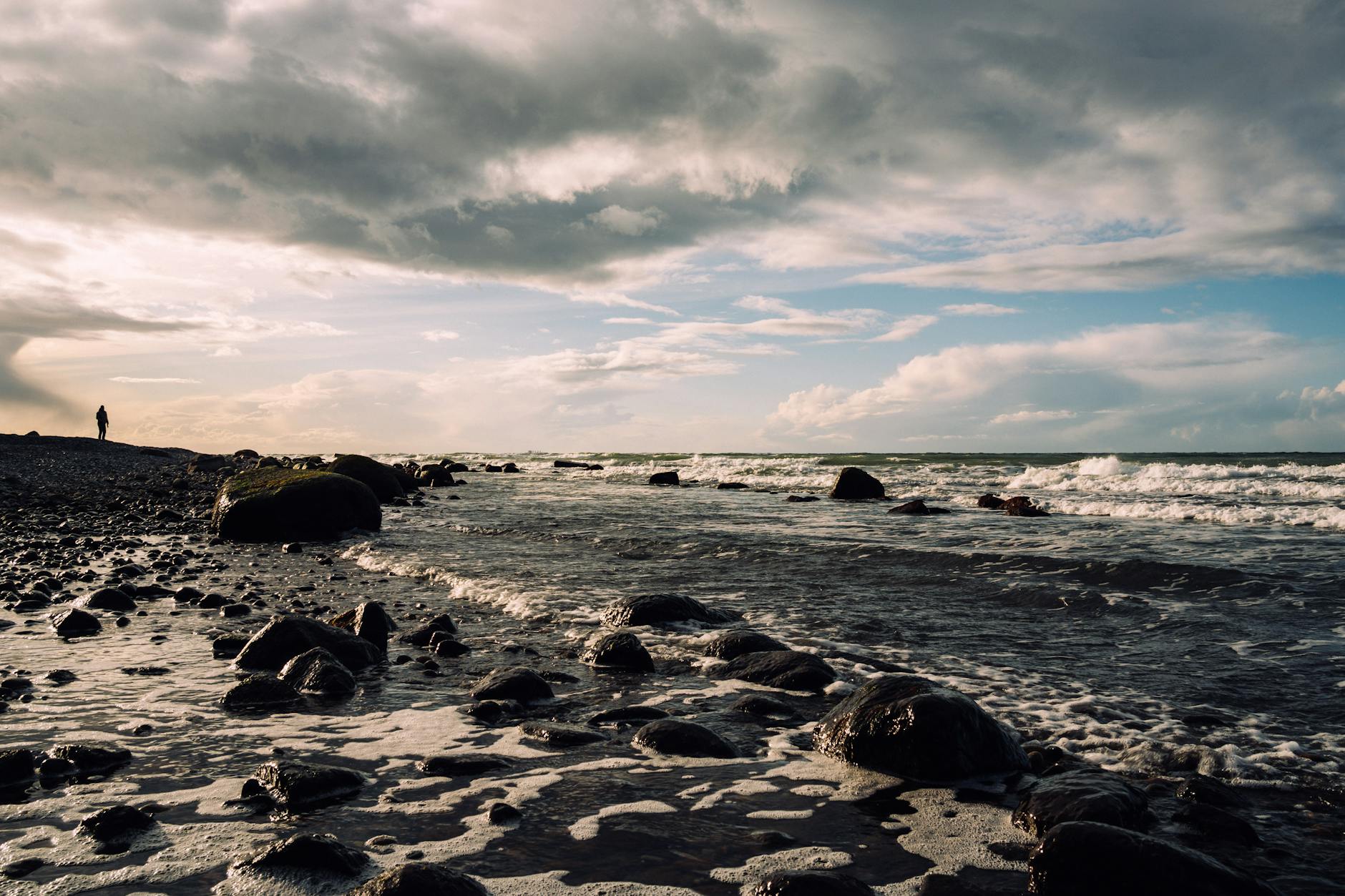
The wind off the Sea of Galilee doesn’t just blow; it pushes. It has weight. You can feel it in your ribs, a sudden, physical shove that makes standing still feel like an act of rebellion. I remember sitting on a worn stone bench in Capernaum, the kind that’s been smoothed by centuries of sandals and bare feet, watching the water chop against the shore. It was late afternoon. The light was turning that bruised purple color that comes right before the sun surrenders for the day.
A fisherman was mending his nets nearby. He wasn’t looking at the horizon. He was looking down, at the frayed twine in his hands, pulling tight, checking for breaks. He knew the sea. He knew that the calm you see in a painting is a lie. The sea is alive, and it is angry, and it is beautiful, and it is terrifying. To stand on the edge and not flinch isn’t courage. It’s trust. It’s the quiet certainty that even if the water rises, you are not alone in the vessel.
That’s what faith feels like. Not a grand, shouting declaration. Just the ability to keep your eyes on the One who speaks the wind, even when your knees are shaking.
The Panic of the Visible
We live in a world that worships data. We want proof. We want the spreadsheet, the graph, the clear arrow pointing up and to the right. If we can’t see the outcome, we assume the process is broken.
Think of Peter.
Just Peter. The loud one. The one who could walk on water but also sank because he looked at the wind. We’ve heard this story so many times we’ve turned it into a cartoon. Peter walks. Peter sees Jesus. Peter sinks. Jesus saves. Moral: Don’t look at the storm.
But read it again. Look closer at Mark 4 or Matthew 14.
The disciples were in the boat all night. They were exhausted. Their muscles burned. They were rowing against a headwind that felt personal. And then, in the fourth watch of the night—around 3 AM, when sleep is deepest and hope is thinnest—Jesus comes. Not by boat. By walking on the churning black water.
But they didn’t recognize Him at first. They cried out, "It’s a ghost!"
Why? Because their eyes were full of the storm.
That’s the trap. We think "living by faith, not by sight" means closing our eyes to reality. It doesn’t. It means seeing reality differently. It means looking at the same 3 AM darkness that terrified Peter and his friends, but seeing the Footsteps instead of the fear.
Peter steps out. He doesn’t wait for the storm to stop. He doesn’t wait for the wind to die down. He steps out into the chaos. And for a moment, it works. He’s doing the impossible. He’s defying physics. He’s living by faith.
Then he looks.
He sees the wind. He sees the waves getting bigger. He sees the distance from Jesus. And suddenly, the narrative flips. Faith becomes sight. And when faith becomes sight, it shrinks. It becomes small, fragile, and terrified.
"I was afraid," Peter says later. "And I began to sink."
How many times have we done that? We start strong. We step out of the boat of our comfort zones. We launch that business. We make that call. We forgive that person. And then—just for a second—we glance at the conditions. We check our bank account. We look at the diagnosis. We notice the awkward silence in the room.
And just like that, the miracle stops being a miracle and starts being a math problem. We sink.
The Quiet Discipline of Looking Up
It’s easy to think faith is an emotion. A high. A feeling of warm cotton in your chest when the worship music swells.
But faith is a discipline. It’s a muscle. And like any muscle, it atrophies if you don’t use it.
In the Old Testament, the Israelites wandered for forty years. Forty. That’s not just a number. That’s a long time. Long enough for a whole generation to die off. Long enough for memories to fade. Long enough for the "miracles" of the Exodus to feel like ancient history.
And what happened? They forgot.
They forgot the manna. They forgot the parting of the Red Sea. They forgot the cloud by day and the fire by night. Why? Because they were looking at the manna. They were looking at the enemies on the hill. They were looking at their own hunger.
says, "How long will this people provoke me? ... If they indeed see my glory and the signs that I have seen in Egypt and in the wilderness..."
They saw the signs. But they didn’t see God. They saw the event, but they missed the Actor.
This is where so many of us get stuck. We wait for a sign. We wait for God to drop a mic drop from heaven. We wait for the road to become straight before we take the first step.
But God rarely changes the road. He changes the eyes.
Think of the blind man in John 9. He wasn’t blind because he lacked faith. He was blind because he was blind. Jesus put mud on his eyes. He gave him a specific, weird, physical instruction: "Go, wash in the pool of Siloam."
The man didn’t know if it would work. He just went. He walked to the pool. He washed. He came back seeing.
Faith isn’t staring at a problem until it disappears. Faith is obedience in the dark. It’s walking to the pool when you can’t see the water. It’s trusting that the mud Jesus put on your eyes was for a purpose, even when it feels messy. Even when it feels humiliating.
I’ll be honest, I’ve struggled with this. I used to read the verse "We walk by faith, not by sight" () and feel guilty. I’d look at my bills, or my lonely apartment, or the slow healing of my back, and think, I’m not trusting enough. I was trying to force my eyes to see what wasn’t there yet.
But it’s not about forcing. It’s about focusing.
It’s about realizing that the "sight" we’re supposed to abandon isn’t reality. It’s interpretation. It’s the narrative we tell ourselves: This is the end. This is failure. This is abandonment.
Faith is the counter-narrative. It’s the whisper that says, This is not the end. This is a chapter. This is refinement.
The Summer of Waiting
It’s early summer now. The days are long. The grass is thick and green, drinking up the rain. There’s a heaviness to the air, a promise of heat and growth.
In the garden, you don’t pull on the seed to make it grow faster. You don’t stare at the dirt and shout at it. You water it. You wait. You trust the process that you can’t fully see.
The world tells us to be active. To hustle. To optimize. To make everything visible, measurable, and immediate.
But the Kingdom operates on a different timeline. It’s the slow ripening. It’s the yeast in the dough. It’s the mustard seed.
Living by faith doesn’t mean we ignore the storm. It means we stop letting the storm dictate our peace.
When the wind picks up—and it will, because the wind always picks up—we have two choices. We can look at the waves, and sink. Or we can look at the Voice that spoke the waves into existence, and step out.
It’s not about having perfect vision. It’s about having the right Vision.
Jesus didn’t say, "Look until you see." He said, "Follow Me."
Follow Him into the uncertainty. Follow Him into the 3 AM darkness. Follow Him into the place where your knees hurt and your eyes are tired.
And when you sink—and you will, because you’re human, and you’re mortal, and you’re fragile—don’t panic. Don’t start swimming frantically. Don’t try to generate your own buoyancy.
Just look up.
And He will reach out His hand. Not to scold you for looking at the wind. But to steady you. To remind you that the same power that calmed the sea is holding you up.
“You of little faith,” He asks, gently, "why did you doubt?"
Not why did you fail? Not why did you sink?
Why did you doubt?
Because you looked away.
So look back.
The wind is still blowing. The waves are still choppy. But you are not alone in the vessel. And you never were.