Have you ever stood on the edge of a decision, heart hammering against your ribs, waiting for the other shoe to drop?
It’s that specific brand of dread. It’s not just worry about a bill or a sick child, though those certainly count. It’s the terrifying sensation that you are about to step out of solid ground into open water, and you realize with sudden clarity: You might drown.
We’ve all heard the story. It’s familiar, almost too familiar. The disciples are in a boat on the Sea of Galilee. It’s night. A storm has kicked up, fierce and sudden, churning the dark water into white-capped chaos. And then, through the driving rain and howling wind, a figure appears. Walking on top of it all.
Most of us read this as a miracle about Jesus. He’s God, after all. Walking on water is kind of what he does. But if you glance closer—past the stained-glass aesthetic and into the messy reality of being human—you’ll find that Peter’s story is actually much more interesting. It’s not only about Jesus’ power. It’s about our fear. And it’s about the terrifying, beautiful act of stepping out anyway.
Let’s look at this through three different lenses: the historical setting, the linguistic weight of what happened next, and the very real chaos of modern parenting.
The Geography of Fear
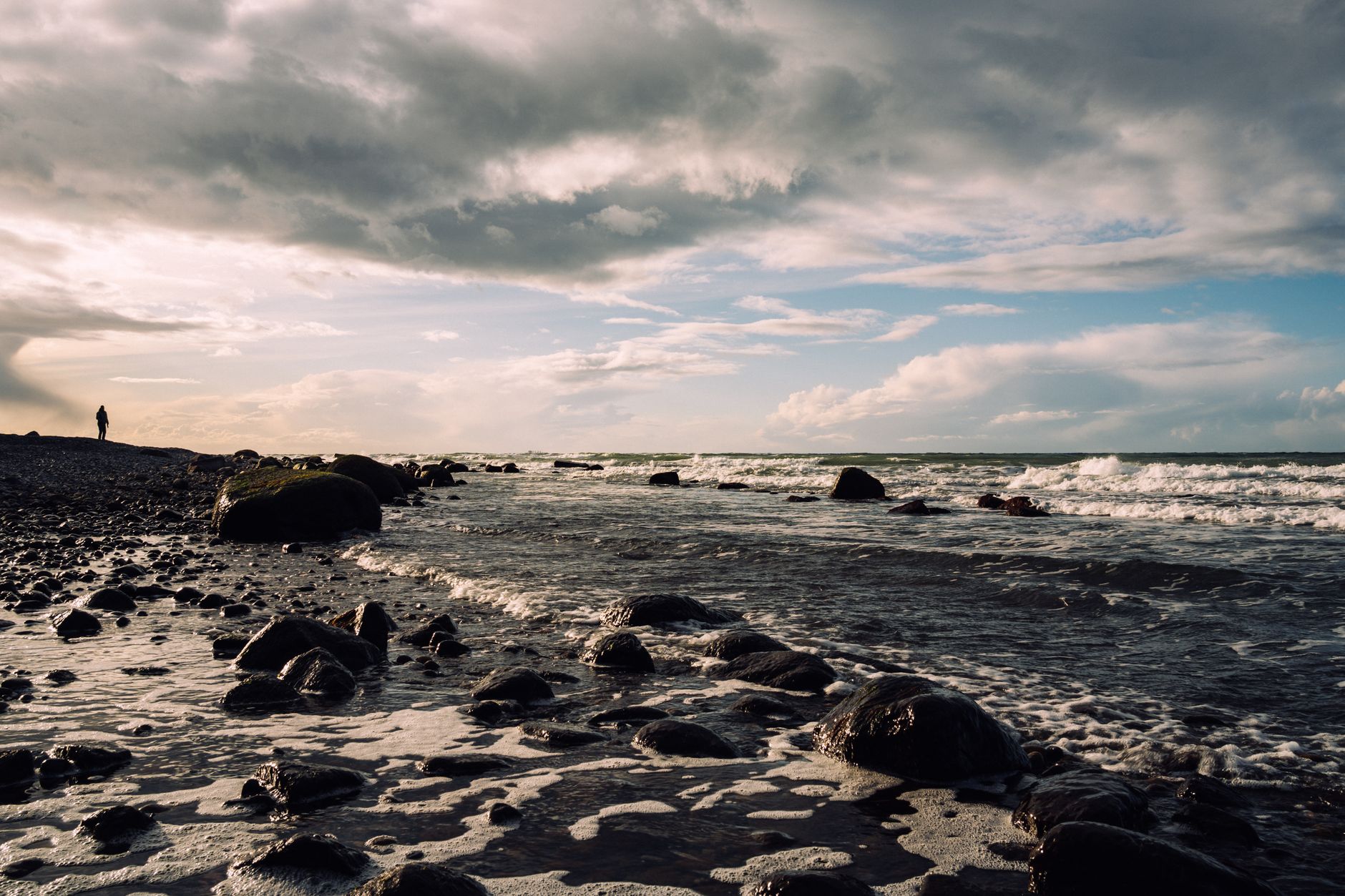
First, consider where they were. The Sea of Galilee isn’t the Atlantic Ocean. It’s a freshwater lake, nestled in a valley surrounded by hills and mountains. On a clear day, it’s calm. But those surrounding peaks trap air masses in a way that creates sudden, violent squalls. A storm can go from zero to sixty in minutes.
So, the disciples aren’t just out on a vast ocean; they’re in a trap. The wind is pushing them away from their destination, toward the eastern shore, but also against them. They are exhausted. tells us they were “struggling with the rowing.” The Greek word here, balantio, implies mixing or churning. They weren’t just tired; they were fighting against the physical resistance of the water and the wind, rowing with heavy, salt-stiffened muscles.
And then, in the fourth watch of the night (around 3 a.m., when humans are at their most vulnerable and tired), Jesus comes to them.
Here’s the thing about fear: it thrives in isolation and exhaustion. The disciples see a ghost. Phantasma is the word John uses in chapter 6:19. They scream. Why? Because their brains, fogged by fatigue and adrenaline, interpret the unknown as a threat. They are scared. And Jesus says, “Take courage! It is I. Don’t be afraid.”
But notice he doesn’t stop the storm. The boat still rocks. The wind still howls. Peace, in this moment, isn’t the absence of chaos; it’s the presence of Jesus within it.
The Leap of Peter
This brings us to Peter. The impulsive, loud, seriously human disciple. He hears “It is I,” and instead of just sitting back in his safety, he asks for something remarkable. “Lord, if it’s you,” Peter says, “tell me to come to you across the water.”
Jesus says, “Come.”
So Peter gets out of the boat.
Think about what he’s doing here. He is stepping onto a substance that has no inherent stability. Water is fluid. It shifts. It supports you only as long as you are moving with it, not against it. Peter walks. He hears the wind. He sees the waves. And then, something shifts in his focus.
describes Peter’s faith as being tested by what he sees. He looks at the storm. The Bible says, “When he saw the wind, he was afraid.” And immediately, he began to sink.
This is where so many of us get stuck. We step out in faith, but then we look at the size of the problem instead of the strength of our Savior. We sink.
But Peter doesn’t stay under. He cries out, “Lord, save me!” And immediately—euthus, the Greek word for quickness—Jesus reaches out his hand and catches him.
There is a clear mercy in that catch. It suggests that faith isn’t about never sinking. It’s about where you look when you start to go under.
I’ll be honest, I’ve struggled with this interpretation for years. I used to think faith meant having everything figured out before you got in the boat. That if you were truly faithful, the water would be solid under your feet until you reached the shore. But Peter’s story teaches me that faith is often a struggle. It’s messy. It’s wet.
It’s looking at the storm, feeling your legs tremble, and taking one step anyway.
The Modern Boat: Mindful Parenting and Trust
How does this apply to us, right here, in our kitchens and offices?
We live in a culture that is obsessed with control. We want the perfect schedule, the healthy meals, the quiet homes, and the secure futures for our children. We want to row efficiently. But life is not a rowing machine. Life is the Sea of Galilee.
Sometimes, as parents or providers, we feel like we are in that boat during a squall. The bills are piling up. The teenager is silent or shouting (usually both). The job market feels unstable. You’re doing everything right, but you feel like you’re churning against the current.
Fear whispers to us: Stay in the boat. The boat is safe. The boat has walls. You can hide behind it.
But God often calls us out of the boat. He invites us to walk on water in ways that seem illogical.
Maybe it’s starting that ministry you’re passionate about, even though the finances aren’t perfect yet. Maybe it’s setting a boundary with a difficult family member, even though you’re afraid of the conflict. Maybe it’s letting go of your adult child and trusting them to work through their own storms, even when you want to rush in and fix it.
These are acts of faith. They require stepping out over the unknown.
But here’s where mindfulness comes in—true, biblical mindfulness. It’s not just emptying your mind; it’s filling it with truth. When Peter looked at the wind, his focus shifted from Jesus to the storm. His faith shrunk because his attention shrank.
Mindful parenting, and mindful living in general, asks us to anchor our eyes where they belong. It’s the practice of remembering who is walking on water with you.
Consider this: When your child has a meltdown in the grocery store, or when you’re working late and the house is quiet, do you look at the chaos (the wind) or at Christ (the Savior)?
If you look at the wind, you feel the urge to sink. You worry about the outcome. Did I do enough? Is this normal? Will they remember this as a failure?
If you look at Jesus, you feel the urge to stand. You remember that His hand is already reaching out.
The Invitation to Step Out
So, what do we do with this?
We don’t need to be fearless. Fear is a natural response to the unknown. Even Jesus, in Gethsemane, felt the weight of what was coming. Fear is not the enemy of faith; it’s often its companion.
The key is that we don’t stay in the paralysis of fear. We step out.
And when we sink—and we will, because we are human—we don’t panic. We cry out.
There’s a beautiful simplicity in that prayer: “Lord, save me.” It doesn’t require eloquence. It doesn’t require a theological degree. It just requires honesty.
I think about my own life, the days when I feel like I’m walking on thin ice. There’s a moment of decision. A breath. And then, the step.
Sometimes that step is small. It’s choosing to forgive when you want to hold a grudge. It’s saying no to an opportunity so you can say yes to what matters most. It’s trusting that God is working, even when the storm rages around you.
Other times, it’s big. It’s moving to a new city. It’s healing from a broken relationship. It’s believing that God is good, even when life hurts.
In all of these cases, the water supports us—not because the water is stable, but because Jesus is holding us up.
A Quiet Question for Your Day
So, here’s the question I want you to carry with you today. Not as a challenge, but as an invitation:
What is the one thing you’ve been afraid to step out on? What’s the “storm” that keeps you in the boat, even though Jesus is standing right there in front of you?
Don’t try to answer it with your head. Sit with it. Feel the weight of it. And then, just one small step toward Him.
The water might wobble. The wind might blow. But His hand is already reaching out.