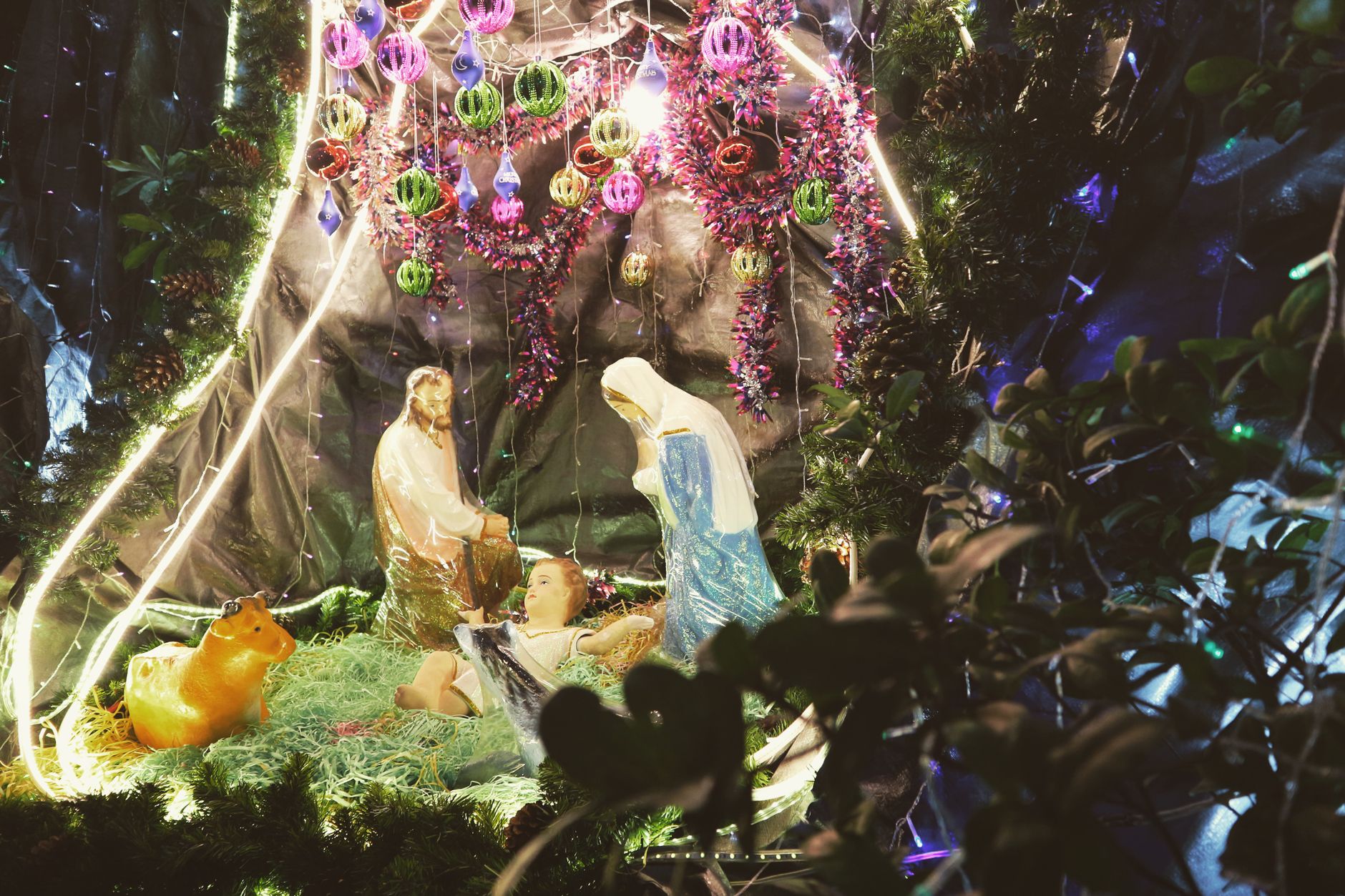
— "For to us a child is born, to us a son is given; and the government will rest on his shoulders. And he will be called Wonderful Counselor, Mighty God, Everlasting Father, Prince of Peace."
Let that sink in.
We usually rush past this verse. We’re too busy looking for the baby in the manger, the shepherds, the wise men. But this is the prophecy. This is the promise that had been hanging in the air since the Garden of Eden. Since Adam and Eve hid behind the fig leaves, God had been whispering, I’m coming. I’m making a way.
And here is the twist that stops me every time I read it again.
God didn’t choose a palace. He didn’t choose a temple. He chose a stable.
Why?
If you’ve ever felt like your life is less than what it should be—like you’re stuck in the "stable" when everyone else is in the "palace"—this is the story you need. It’s not just about Jesus’ birth. It’s about how God uses our limitations to make His power shine brightest.
Here are three ways to look at this truth.
1. The Scripture Says: The Ordinary Was the Chosen
We tend to think God operates in the extraordinary. We wait for a sign. We wait for a door to open. We wait for a miracle that looks like a miracle.
But look at the details of Jesus’ birth.
— "She gave birth to her firstborn, a son. She wrapped him in cloths and placed him in a manger, because there was no room for them in the inn."
A manger. That’s what you put hay in for the animals.
Think about that. The Son of God, the Creator of the universe, was laid in a feeding trough.
It was humble. It was practical. It was ordinary.
And yet, that was where the government of the universe was set up.
This teaches us something profound about God’s economy. He doesn’t need our grandeur. He needs our availability.
When we think we are too small, too insignificant, too "stable-like" for God to use, we are missing the point. God specializes in taking the overlooked and making it the centerpiece.
I’ll be honest—I’ve struggled with this. I’ve looked at my life and thought, "Lord, this isn’t the plan. This is too quiet. This is too small." I wanted a bigger stage. I wanted a louder voice.
But the stable reminds me that quiet and small are not the enemies of God’s power. They are often the canvas where His presence is most visible.
2. The History Shows: The Promise Had a Timeline
You can’t understand the weight of Jesus’ birth without understanding the wait.
For centuries, the Israelites were under foreign rule. They were a people without a king, without a protector. They were scattered. They were tired.
And God kept saying, Not yet. Not yet. Not yet.
Why did He make them wait?
Because a promise that arrives too soon is often taken for granted. A promise that arrives after a long wait is cherished.
The birth of Jesus wasn’t just an event. It was a deadline met.
Imagine the tension in the air in first-century Judea. People were expecting a Messiah. They were expecting a liberator. They were expecting a king who would overthrow Rome.
And then, a baby is born in a town so obscure it wasn’t even named in the census records.
The history tells us that God’s timing is not our timing. It is slower, yes. But it is also more precise.
When the clock finally hit zero, the promise didn’t just arrive. It exploded into reality.
This is why the story of Jesus’ birth feels so heavy. It’s not just a cute story about a baby. It’s the culmination of a story that started with the fall of man. It’s the answer to the oldest question in human history: Will God really come down? Will He really save us?
The answer, whispered in a stable in Bethlehem, was Yes.
3. What It Means Today: Your "Stable" Has a Purpose
Maybe you’re in the middle of a season that feels like a stable.
Perhaps you’re working a job that doesn’t feel like your calling. Maybe you’re in a relationship that feels stagnant. Perhaps you’re in a place geographically that feels far from where you think you should be.
You might be feeling like you’re waiting for the "inn" to open. You might be feeling like there’s no room for you in the places you want to be.
Here is the encouragement I want to offer you:
The fact that you’re in the stable doesn’t mean God has forgotten you. It may mean He is preparing you.
Jesus grew up in Nazareth. He worked with His hands. He knew what it was like to be ordinary. He knows your struggle. He knows what it feels like to be overlooked.
And because He knows, He can identify with you.
When you feel disqualified because of your circumstances, remember that the King of Kings was disqualified by the standards of the world. And yet, He was the most qualified person in history.
Your current situation is not your final address. It is your training ground.
It is in the stable that you learn patience. It is in the stable that you gain dependence on God. It is in the stable that you discover His provision is enough, even when it’s not what you expected.
— "By faith Abraham, when called, went out to a place he was going to receive as an inheritance. He went out without knowing where he was going. By faith he lived as a foreigner in the land of promise, in a tent, as did Isaac and Jacob, who were heirs with him of the same promise. For he was looking forward to the city with foundations, whose designer and builder is God."
They dwelt in tents. They resided in temporary housing. They occupied the "stables" of the promised land.
And yet, they had their gaze fixed on the city.
Where are your eyes today?
Are they locked on the stability of your current situation? Or are they anchored in the stability of God’s promise?
If you stare at the stable, you’ll see limits. If you gaze at the promise, you’ll see possibilities.
One Concrete Action for This Week
Don’t just read this and nod. Take one small step.
Here is what I challenge you to do this week:
Write down one specific thing that feels like a "limitation" in your current life. Then, write down one specific way God has already shown His presence or provision in that exact area.
For example:
- Limitation: I’m still working part-time while going to school.
- God’s Provision: I’ve received two scholarships this semester that I didn’t expect, and my family has been praying for me daily.
See the difference? The limitation is real. But the provision is also real. And the provision points to a bigger story than just the part-time job.
Do this exercise. Get it out of your head and onto paper. Look at both columns.
Which one is bigger?
Often, we only see the limitation because it’s loud. It takes up space. It demands attention.
But the provision? It’s quiet. It’s steady. It’s there, but it doesn’t shout.
When you write it down, you give it space. You make it visible.
And once it’s visible, you can’t ignore it.
You can’t ignore the fact that God is already moving.
He’s already provided. He’s already present. He’s already promising.
Even if the stable feels dark and cold, the light is coming.
It’s already on its way.
And one day, you’ll look back and realize that the stable wasn’t the end. It was the beginning.
It was the place where the King was born.
And that changes everything.